ADRENALINE
Adrenaline has a major effect on a dog’s ability to learn and needs to be considered in every learning or behavioural-change context.
Adrenaline and Cortisol are the body's primary stress hormones. Adrenaline triggers the rapid "fight or flight" response, while cortisol maintains the elevated energy and focus needed to handle physical or psychological stressors.
Looking at Adrenaline:
The body is constantly picking up signals from the surroundings using all the senses, and sending messages to the brain.
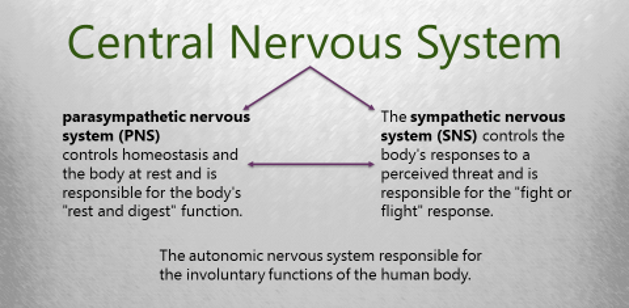
As soon as we (subconsciously) sense a threat, the part of the brain called the amygdala gets activated; this “threat-sensor” works faster than the response time to the rational part of our brain - the prefrontal cortex - that may tell us it isn’t a problem.
Put simply, if the brain is presented with new, novel things or situations or something dangerous, scary or painful, it changes the body chemistry so the body can protect itself. This is involuntary, the dog has no control over its production.
Released almost immediately from the inner adrenal glands (medulla), adrenaline drives short-term survival by:
Increasing heart rate and blood pressure to pump blood rapidly to major muscle groups.
Produces energy by triggering release of glucose and fats for quick fuel.
Narrowing attention and quickening reaction times.
This chemical change has a profound effect on the dog, who will….
Need to release the energy produced (e.g. this may include pulling on the lead, being mouthy, grabbing at clothes or arms, frantic running, barking, lunges)
Will not be able to “think”, e.g. unable to process what we are asking for, or to make decisions
Be unlikely to recognise or respond to food/rewards
It is hard to be with a dog when they are in this state as they are likely to be physically difficult to hold, can be mouthy, jumpy, destructive, vocal and can sometimes appear quite frantic.
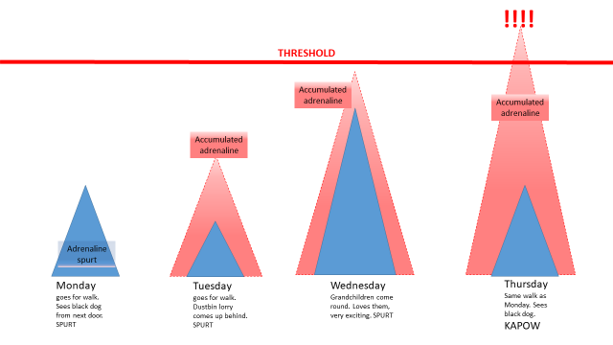
Adrenaline “spurts” can stay in the body for some days, and therefore can accumulate. Some “spurts” may come from general life (e.g. a noisy lorry, something moving in our peripheral vision, a dropped plate). Sometimes the dog has built up certain “triggers” that they always react to, such as other dogs, children, umbrellas…..
If the body has a build-up of adrenaline, new “spurts” can instantly take the dog over the threshold. It doesn’t always have to be a known trigger….. and it may not be clear what has taken them over, which is why a dog can sometimes appear to cope, and another time “lose it”, in the same situation.
This is why we may have suggested an Adrenaline/Cortisol Holiday for your dog; to reduce background adrenaline so there is more room before they hit the threshold!
What can cause adrenaline build up? Examples:
over-tiredness,
new experiences,
stress,
confusion,
fear of other dogs/people/vet/car/traffic etc etc
over enthusiastic, poor or harsh handling,
greetings,
putting harness on,
playing,
some types of food,
ball chasing games,
growth pains,
teething,
noise
pain and discomfort
We have talked about your individual pup or dog and how Adrenaline may be affecting them and, most importantly, how you can help reduce their stress hormones, which will help remove that block to learning.
Videos Adrenaline and/or APDT Adrenaline Talk